Poker Big Win
The best video poker experience on the go. All the Free Video Poker Games you know and love. Win big with progressive jackpots and hourly bonuses. Compete for top stop against other Video Poker players. Real Vegas card shuffler. Statistic tracking. Huge payouts. Win the Royal.
Antonio Esfandiari was the big winner, taking home nearly $18.35 million—the highest single poker tournament payout in history. Take a look at the final hand where Esfandiari’s 75off beat Sam Trickett’s suited Q6. Esfandiari, justifiably, cannot hold back his excitement. Other notable poker tournament wins. The following is a glossary of poker terms used in the card game of poker.It supplements the glossary of card game terms.Besides the terms listed here, there are thousands of common and uncommon poker slang terms. This is not intended to be a formal dictionary; precise usage details and multiple closely related senses are omitted here in favor of concise treatment of the basics. The best video poker experience on the go. All the Free Video Poker Games you know and love. Win big with progressive jackpots and hourly bonuses. Compete for top stop against other Video Poker players. Real Vegas card shuffler. Statistic tracking. Huge payouts. Win the Royal.
Everyday players are sitting down at the tables and consistently making fundamental mistakes because of lack of knowledge, misinformation or failing to maintain focus.
Even just a small strategical adjustment in poker can potentially save you a huge amount in the long run.
In this article we will point out some of the best live and online poker tournament strategy tips you can use to improve your game as quickly as possible.
Tip 1: Play The Right Starting Hands
Whether it be lack of patience, or an unfamiliarity with opening ranges, many tournament poker players still open too wide. This is especially true when it comes to early and middle position opens, where there are still many opponents left to act behind who can be dealt a strong hand.
The problem is when called, wide openers are often at a range disadvantage. Often being dominated by their opponents, they are vulnerable to 3 bets since they frequently won't have a holding strong enough to continue under pressure.
Furthermore, although opening a hand like 7 ♠ 5♠ might at times not be a terrible strategy from early or middle position, speculative hands like suited connectors and gappers, as well as small pairs, work best with deep stacks behind.
These speculative hand types infrequently connect strongly with the flop, so those times they do you want to have deep stakes behind to have the potential to win a huge pot. Modern day tournament structures often only see deep stack play occur during the first few levels of play. This leads us into the next tournament poker tip, being stack size aware.
Learn which hands to open raise in MTT's - Watch lesson 6.1 from the Road to Success MTT Course. A power-packed 50 minute video below, just use one of the button options to unlock it and get instant access.
Tip 2: Be Stack Size Aware
Effective stack size plays a critical role in a tournament players success.
Having a deep stack, and therefore expanding an opening range to include a lot of speculative suited hands and small pairs is a tournament strategy that is going to be punished if a number of short stacks are yet to act behind. This most notably occurs in turbo tournaments where the average stack size is quite short.
Short stacks will be in push-or-fold mode. Being short, they don't have time to wait and will be looking to take any opportunity they can to move all-in. This high rate of all-ins will leave wide openers frequently being forced to relinquish their hands, without even having the opportunity to try to hit a nice flop. Problematic hands often include; J8s , KTo and weak Ax hands.
It's not just short-stacks that can cause a problem, aggressive players will be looking to attack wide-openers. This is especially true when a player opens with a vulnerable M8-M14 (20bb-35bb) stack. 3 bets get good leverage against this stack size, since continuing in the pot represents committing a significant portion of a players stack.
Wide openers would be wise not to commit a large percentage of their stack with marginal holdings, and so will be forced to fold, or face being in a high-risk situation. Staying aware of your own stacks utility, as well as anticipating how opponents will utilize their stacks, is an important tournament poker tip to keep in mind.
POKER TIP: If you are currently using BB to calculate stack size, here's a look at why using 'M' is a better MTT strategy.
Tip 3: Be Careful Overplaying In The Early Stages
As a stack gets deeper, the less willing a competent player will be to put their entire stack at risk since they have more to lose. It's rare to see good players all-in during the early stages of a tournament with hands like AKo or JJ preflop.
Smart players recognize that their counterparts aren't going to be risking their entire stack with weaker hands like AQo . Therefore, even a strong hand like AK could be at a significant equity disadvantage facing a deep stacked opponents all-in range. Could you fold QQ here?
Rather than putting in an extra raise, often times just calling with even very strong hands in the early stage of a poker tournament has great benefits.
- Allows your opponents to continue with hands they were folding to a re-raise that you have crushed.
- Disguises the strength of your hand and keeps you unpredictable.
- Prevents you from getting all-in facing a super strong range where often times you're crushed.
Tip 4: Continuation Bet Aggressively But Not Always
Players have learnt the value of c-betting, but it's a strategy that is often misapplied. Being the preflop aggressor shouldn't lead to a mandatory c-bet and double barrels.
This is especially true in multi-way pots yet players continue to make fruitless c-bets with weak holdings into multiple opponents.
Even in heads-up situations, key factors to consider include;
- How does the flop texture interact with players ranges?
- Who has the strongest range?
- Who has nut advantage (the biggest share of super strong hands)?
- How passive or aggressive is the opponent we're facing?
- How does the stack size/SPR allow us to operate on the flop and future streets?
The following hand illustrates the effect nut advantage can have on profitable continuation betting and how it applies to this tournament poker tip:
Tip 5: Be ICM Aware
The Independent Chip Model or ICM, is a great model players use to make more profitable decisions when deep in a tournament and especially at a final table.
Unlike in cash games, chip values fluctuate depending on the stage of the tournament and the competing opponents stack sizes. At it's most extreme, ICM strategy can make A♠A♣: an easy fold preflop.
Imagine a situation in a satellite where 9 players get a World Series of Poker entry and there's 10 remaining. The action folds around to a player with 100,000 in tournament chips who moves all in from the small blind. You're sitting in the big blind with A♠A♣: and also 100,000 in chips. You look around and see a few opponents with only 1000 chips left, which is the size of the current big blind. Obviously one of these short stacks is likely to bust very soon.
Obviously one of these short stacks is likely to bust very soon. Moreover the chance that they collectively out survive your 100,000 stack is extremely remote. You'd likely be a 99% chance to get a WSOP entry, so why would you call with your A♠A♣ and risk busting next around 20% of the time?
Aside from calling too wide in spots when the most profitable strategy is to proceed tightly, the opposite can also be true when it comes to pressuring your opponents. ICM allows players when they have the opportunity to assert pressure on there opponents stacks, to go ahead and do so liberally, since thinking opponents counter-strategy is to play a tight range of hands.
Here's an example of how drastically a hand range can change when the opportunity to assert pressure at a final table exists. 5 of the 6 remaining players at the Pokerstars Sunday Millions have 15bb's, whilst the UTG player has a short 2bb stack. Since the 15bb stacks wants to avoid busting out next and missing out on a large pay jump before the immanent bust out of the 2bb stack, the small blind can adjust their all-in range. Instead of the profitably 57% all-in range in normal play, they can move all-in with 100% of hands to apply pressure on the big blind.
Whilst the big blind should adjust their calling range from the regular 36% to just 10% of hands to account for the ICM effect in play.
The PokerNerve Road to Success course teaches players how to master ICM situations, which is key to tournament poker success since ICM comes into play as the prizes become significant. If there was only one tournament poker tip that you take away from this article, it's that you need to know ICM!
Tip 6: Bet The Appropriate Size
Strong players are capitalizing on their opponents tendencies to bet too big or too small in a number of different situations. With some similar considerations to that of continuation betting, when selecting a bet size important aspects include;
- Which player's range does the board texture favor?
- Who has the greatest nut saturation?
- How does SPR influence our betting strategy
There are many great articles online about bet sizing. You should be sure to check out ThePokerBank's and the Pokerology's to learn more about this tournament tip.

Free MTT Poker Training:
The Underused MTT Skills Essential For Success
- 5 Day Email MTT Poker Training Course By Poker Pro Kelvin 'Acesup' Beattie
- 3 Key Skills That Will Take Your MTT Poker Game To A New Level
- 1.5 Hours Of Professional Poker Training
Tip 7: Take Equity Realization Into Account
Possibly due to the popularity growth of Twitch, many poker players approach to big blind play has evolved. The current trend is to defend the big blind with virtually any 2 cards, as some top pros elect to do, and the justification for this is taking advantage of the excellent pot odds being offered.
While the inclusion of antes combined with commonly seeing a small open raise size does offer the big blind generous pot odds, this has led to a fundamental flaw in the way many players approach big blind play in poker tournaments. The key concept overlooked, is equity realization.
Equity realization reflects a players ability to take a certain hand, and win their share of the pot, frequently enough, to make it profitable in the long-term. Although some top pros have the ability to win their equity share of the pot even out of position, less skilled players rarely do. This leads to a large chip loss in the long run.
It is quite difficult to realize of your equity when out of position, with no initiative and a weak range. This means them glorious odds you are being offered aren't quite as good as you think!
The following article explains this crucial tournament poker tip in more detail; Equity Realization.
Tip 8: Don't Miss Double And Triple Barrel Opportunities
'One and done' is the plight of many aspiring tournament poker players. Everyday at the tables I see players missing profitable opportunities to double, or even triple barrel. Understanding what turn and river cards are advantageous to a players range, along with opponent tendencies, are crucial parts of a winning barreling formula.
The most common scenario at the table, is a heads-up pot where the big blind calls an open-raise. And this happens to be a great spot to barrel. Big blind defenders have a wide range, and it's important to pressure this wide range, especially on only partially connected board textures with one or multiple high cards.
RedChipPoker has a great article on spotting profitable double barrel opportunities which you can read here: THE +EV DOUBLE BARREL GUIDE
Tip 9: Check-Raise More Flops
The biggest difference between the current tournament population, and the future generation, will likely be their approach to check-raising the flop. This opportunity typically occurs in a heads-up pot, after defending the big blind verse an opponents raise.
Currently, MTT players only check-raise the flop in this situation around 7-8% of the time, when closer to 20% is a more optimal strategy. On certain flop textures, check-raising close to 25% of the time is an extremely profitable strategy. And if players are getting out of line with their c-bets, then check-raising at an even higher frequency could be a profitable exploit.
By giving up too easily on a wide range of board textures, or taking a more passive approach and simply calling, c-betting can be done with reckless abandon. However, by selecting a nice mix of check-raising hands, combining some strong hands with some good semi-bluffing candidates, a check-raiser can become tricky to play against and exploit the average players tendency to over c-bet.
POKER TIP: Applied correctly and check-raising becomes a super powerful weapon in your arsenal leading to more profitable poker results. But also think beyond the flop, there's plenty of check-raising opportunities you may be missing. This video demonstrates an interesting turn check-raise situation.
We discuss check raising strategy in more detail in our post over on unfeltedpoker.com.
Tip 10: Develop A Good 3betting Strategy
Whilst 3 betting aggressively is a strategy many players employ, especially in online poker circles, failure to apply optimal 3 betting strategies has certainly led to a lot of spewy poker. Simply attacking opponents who are suspected of opening wide doesn't cut it in the modern poker world.
Players have learnt to deal with 3 bets more profitably, by mixing in some calls with timely 4 bets. Moreover, the role stack size plays when it comes to 3 betting it still largely misunderstood by much of the poker community.
Sure there are certain stack sizes where 3 bets gain a lot of leverage, but how about the role blockers play? And when is 9♦7♦ a better 3 bet candidate than K♦T♠ ? These are just some of the considerations when it comes to a profitable 3 betting strategy. See how to design strong 3betting ranges in this article by Donkr.
Bonus Poker Strategy Tip: Avoid and Deal with Downswings
As a poker player you want to earn your money as easily and as stress-free as possible right? Well, understanding ROI, variance and bankroll management can help (see TopPokerValue's article on bankroll management).
All poker players at some point experience downswings. In some cases, this can affect their play, volume or state of mind.
You'll be miserable, hating poker, playing less and earning less per tournament as your play will suffer.
Along with finding ways that work for you to keep a positive mindset, taking pro-active steps can help keep you confident by knowing you are dealing with the situation like a professional whilst at the same time taking positive action to get back on track and winning.
What is ROI and variance?
Every tournament you enter has an EV associated with it. So if you enter a $10 tourney, as a good player maybe you have a 30% ROI, so you make $3. So it doesn't matter whether you brick that tourney or win it for $5000, you make $3 in the long run.
Now, of course, you don't make $3 each time. 80-85% of the time you lose that $10, some percentage of the time you win a little bit, and some very small percentage of the time you win a lot. How small those ‘small percentages’ are primarily depends on not only your skill edge, but also the field size which is an extremely important concept that is often ignored.
Variance is a factor of two things:
1) Your edge
2) The field size
Example 1)
You play the Hot $55 which has $30K guaranteed, every day for a year on Pokerstars. It has 1600 runners and you have a 5% ROI, because turbo ROIs are small. Your average yearly profit is $605 however you will lose money on the year 55% of the time.
Example 2)
You play a $20 tourney with $3K guaranteed on a softer site every day for a year. It has 200 runners and you have a 30% ROI, because it's a normal speed tourney and you’re against an easier field. Your average yearly profit is $2400 and in this case you lose money only 12% of the time.
A lot of people would look at those two tournaments and make a decision based on the buy-in and 1st place prize money as to which was better to play, and it would be grossly wrong. Once you accept all the above, you realise that the 'up top' number is largely meaningless.
Yes, on the same site bigger fields may mean a lot of fish have registered to play, but you'll find a lot of small field, soft, non-peak hour tournaments have a great pro-to-fish ratio and hence are great value. Of course once you consider other sites that have smaller fields, you'll often find they are a better choice than what might be running on Pokerstars.
So what can you do?
When players start losing money and along with that, confidence, not only does their game deteriorate but they often compound that problem by failing to make rational decisions. Often losing players, or players on a downswing, go 'bink chasing' and decide to take a shot to win all their money back in one tourney. Or load up some quick $82 hyper-turbos to try to turn it all around quickly.
People get overly fixated on what's 'up top' and wanting to score big in one tournament. That’s a sure-fire strategy to fuel a down swing. If your house got knocked down would you try to slap it back up in a week? Take that opportunity to rebuild a better, stronger house.
Make sure you're adding in some study and keep focused (see Sky's Matsuhashi How To Study Poker series), and stay fresh and positive as you approach each session. Be smart and get back into profit quicker instead of enduring a 6-12 month variance rollercoaster!
Closing Words On Tournament Poker Tips
Poker is a multi-faceted game which makes it fun but challenging. Challenge yourself to factor in the relevant concepts, and make more profitable decisions. Tighten up from the big blind, and in general around the table. This tip often quickly improves a new players results, or those that have a got a little sloppy with their play.
Calculate stack size using 'M'. Always be aware of your own, and your opponents stack sizes so you don't get yourself caught in awkward situations. One awkward situation that often comes up is when you hold an overpair to the board and an opponent puts the heat on you. Don't be afraid to make big lay downs to preserve your stack, especially in the early levels.
Be aware of your cbetting frequency. There's no need to waste tournament poker chips cbetting every time, especially when the pot is multi-way. Pick your spots to make profitable plays. Remember when it comes to the final table, regularly profitable playing ranges might alter due to the payouts. ICM is the key when it comes to those final big decisions.
Another key to success is knowing when to fire multiple bullets at your opponents. Barreling, especially against a wide big blind range can really help increase your non-showdown winnings. Finding ways to accumulate chips without always having the best hand is what top players do. This is why check-raising and having a good 3 betting strategy is so important. Correct use of these strategical concepts and the other tips outlines will get you winning more at the tables.
Now that you've acquired some great holdem tournament strategy tips to help you achieve MTT success, go out there an implement them!
One of the quickest way to improve your poker game is to take on a poker coaching, a course or join a poker training site; if that is something that interests you be sure to check out the PokerNerve road to Success Course for some advanced poker tournament strategy or you can check out HowToPlayPokerInfo's guide on poker training & poker courses to find the right option for you.
Any other poker tournament strategy tips? Leave them below in the comments, we would love to hear them!
In order for you to become a successful gambler, you need to know when to bet big when you’re gambling. The strategies for betting big vary from game to game, and I get to dig into why that is here.
In today’s post, I’m going to cover when you should bet big in poker.
The answer is as different from when you should bet big in blackjack as it is from when you should bet big in craps.
Poker Isn’t a Casino Game
When you’re writing about casino games like blackjack, craps, or slot machines, the ideas behind the games are different than they are from poker. That’s because casino games are banked by the house rather than the other players. It’s also because poker games allow you to vary the sizes of your bets multiple times throughout a hand.
With a casino game like blackjack, you make a bet and play your hand. You MIGHT get an opportunity to bet again if you double down or split your hand, but those are special circumstances.
In craps, you place your initial bet, and you get an opportunity to take or lay odds after that. You’re still limited to just a couple of bets.
With a slot machine, you just put in your money and hope for the best. You can switch machines to play for different stakes, but that’s about it.
In none of those cases can you change the stakes in multiple rounds like you can in poker.
Also, with casino games, the odds don’t change much situationally, certainly not in a way where you can adjust the size of your bets during a hand. Blackjack comes close, but you still have to change the size of your bets in between hands, not during them.
In real money online poker, though, the situations are always changing. Good poker players have a brake pedal and a gas pedal, and they know which to use when.
How Betting Works in Poker
The betting structure varies based on which version of poker you’re playing, but they all have the same actions in common. When it’s your turn to act, you can make one of the following bets (or “not-bets,” as the case may be):
- Bet
- Check
- Call
- Fold
- Raise
You can bet if no one has bet before you on that round. When you do, anyone who acts after you must at least match your bet to stay in contention for the pot. Betting is, by its nature, an aggressive act in poker. The size of your bets is determined by the rules of the game you’re playing in.
You can also check if no one has bet before you on that round. When you check, you don’t put any money in the pot, and everyone who acts behind you has the option to also check. You stay in the hand, but if someone behind you bets, you have to decide whether to put money into the pot in response to that. Checking is a passive move.
If someone has bet before you, you can call their bet. This means that you put the amount of money they bet into the pot and stay in the hand. Calling is also a passive move. If someone has bet before you acted, you can also fold. You don’t have to put any money into the pot, but you also forfeit any claim to it. You’re out of the game until the next hand.
Finally, if someone has bet in front of you, you can raise the size of the bet. The rules for the amounts you’re allowed to raise are based on the rules for that table. Raising is also an aggressive move, just like betting is.
Bet Big in Poker When You Think You Have the Best Hand
Generally, aggressive poker is better than passive poker. If you’re planning to compete for a pot, it’s usually better to be betting and raising than it is to be checking and calling. If you’re going to fold, it’s moot.
When you bet and raise, you accomplish two things:
- You force your opponent to make hard decisions. He either has to call, re-raise, or fold. If he’s not confident in his cards, it’s a tough decision. If your opponents all fold, you win the pot by default. It’s impossible to win a pot uncontested unless you’re betting and raising.
- You get more money into the pot when you do win a contested pot. You can’t count on your opponents to bet and raise when you check. You also can’t count on subsequent players raising when you’ve called a bet. If you want to get more money into the pot, the way to do so is to keep betting.
Betting and raising are the keys to succeeding at poker. You’ll find loose aggressive players who are winners, and you’ll also find tight aggressive players who win.
But you’ll never find passive players in the winner circle at the poker table.
Bet Big in Poker When You’re “Taking a Shot”
When you’re playing in a poker tournament, you’re basically making one large bet at the beginning of the tournament. That bet pays off based on how you place during the tournament. The chips in the tournament change value based on how long you’ve been playing and on how many people are left in the game.
You’ll find plenty of bankroll management advice on the internet that suggests profitable poker players should never risk more than 1/20 of their poker bankroll on a tournament buy-in. Some suggest being even more conservative than that.
For the most part, that’s good advice. You shouldn’t be constantly playing in poker tournaments that are way beyond your ability or bankroll. In fact, if you’re a lousy player, you’re better off sticking with the lower stakes until you improve.
The short answer to that is, yes, it’s worth it to take a shot at a big tournament. I learned this from a poker mentor of mine. I’d never even heard of the concept of “taking a shot” before talking to him.
The trick is to make sure the money you’re laying down for the tournament entry fee isn’t something you need for something more important (like the rent maybe).
Your chances of winning the tournament or even getting into the money are lower than you might think. It depends on your skill level. It’s still okay to take a chance and go for it, though, especially if you have a means of building up a new stake in a short period.
I used to work with some poker players who made a good living. They were sometimes broke on Friday morning, but they got paid that day, so losing a little money during the Thursday night poker tournament wasn’t that big a deal to them.
None of them were ever worried about not having enough money to pay the electric bill or to pay the rent.
You Should Also Bet Big in Poker When You’re Bluffing or Semi-Bluffing
Most poker beginners bluff too often. They don’t understand that bluffing in poker is only mathematically profitable when it makes sense to do so. Paying attention to your opponents’ playing tendencies is one way to know when it’s okay to bluff and when it’s not.

If you’re heads-up with a player who calls everyone down to the river—a real “sheriff” type—bluffing just won’t work. It doesn’t matter how big your bets are.
If you estimate that the sheriff only has a 10% probability of folding, you shouldn’t be betting more than 1/10 of the pot to try to get him to fold.
And if he has any sense at all, he’ll realize that he’s getting 10 to 1 odds to call, which means that most playable hands are okay in this situation.
No, you need to restrict your bluffing to players who are tight and are apt to fold in the face of your aggression. And the bet needs to be big enough that your opponent has a realistic chance of folding in the face of it.
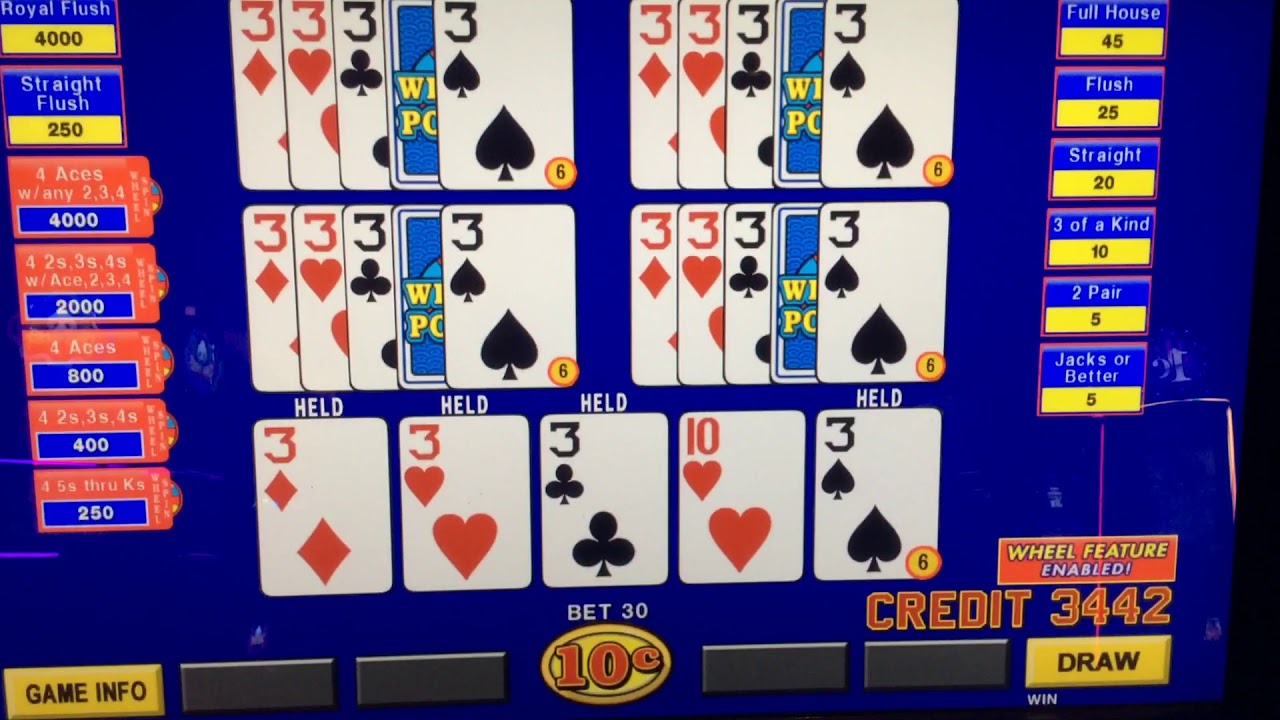
Poker Machine Big Wins
You should also understand that it’s hard to bluff more than one or two opponents at a time. The goal is to win the pot uncontested. The more players you’re trying to scare off, the lower your likelihood of your success.
You should also bet big when you’re semi-bluffing. A semi-bluff is when you bet or raise with a hand that is probably not the best hand, but it’s a hand that has a reasonable chance of improving to the best hand. When you’re semi-bluffing, you’re giving yourself two ways to profit.
You win money when your opponents fold. But you also win money when they call you and you hit your drawing hand.
I prefer semi-bluffing to bluffing, period. Either way, you should get used to betting big in those situations.
Conclusion
When should you bet big in poker? The answer is simple—when it makes sense to do so.
You should bet big when you have a good hand. You should also bet big when you suspect you have a chance of winning a pot uncontested, say in a bluffing or semi-bluffing situation.
One thing you’ll learn about poker is this: Betting aggressively is rarely the wrong move unless you just plain have a lousy hand. You can’t bet every hand aggressively, but if you’re at a passive enough table, you can steal a lot of pots just by betting and raising.